


What India’s insurance transformation means for businesses, corporate leaders and decision-makers
India’s insurance industry is entering one of the most significant phases of transformation in its history.
The move towards permitting 100% foreign direct investment (FDI), together with a wave of strategic investments, acquisitions and digital-first entrants, marks a defining moment for one of the world’s largest underpenetrated insurance markets.
It is more than just a regulatory change.
While the policy change itself has attracted considerable attention, its implications extend far beyond foreign ownership.
For businesses, this is not simply a story about more capital entering the sector.
It is about how that capital will influence the institutions behind insurance – shaping underwriting philosophies, governance standards, technology adoption, claims management and long-term strategic direction.
India’s insurance market has long been recognised for its immense growth potential. Greater foreign participation is expected to bring stronger balance sheets, global expertise, increased competition and broader product innovation. Together, these developments have the potential to strengthen the industry and improve outcomes for policyholders.
Yet they also raise an important question.
As India’s insurance market evolves, should businesses also rethink how they evaluate their insurance partners?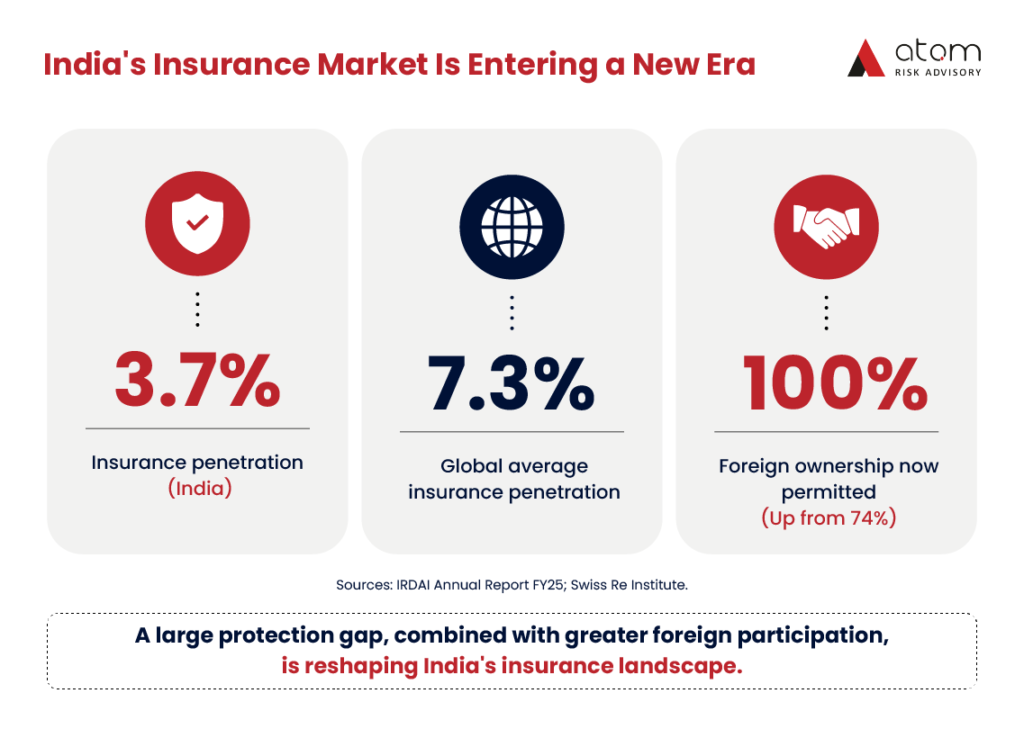
A Market Moving at Speed
The pace of change across India’s insurance industry has accelerated considerably.
Within a relatively short period, the sector has witnessed a series of strategic investments, ownership changes and new market entrants that collectively point to a more competitive, better-capitalised and increasingly global insurance landscape.
Viewed individually, these are important corporate announcements. Viewed collectively, they represent something much larger.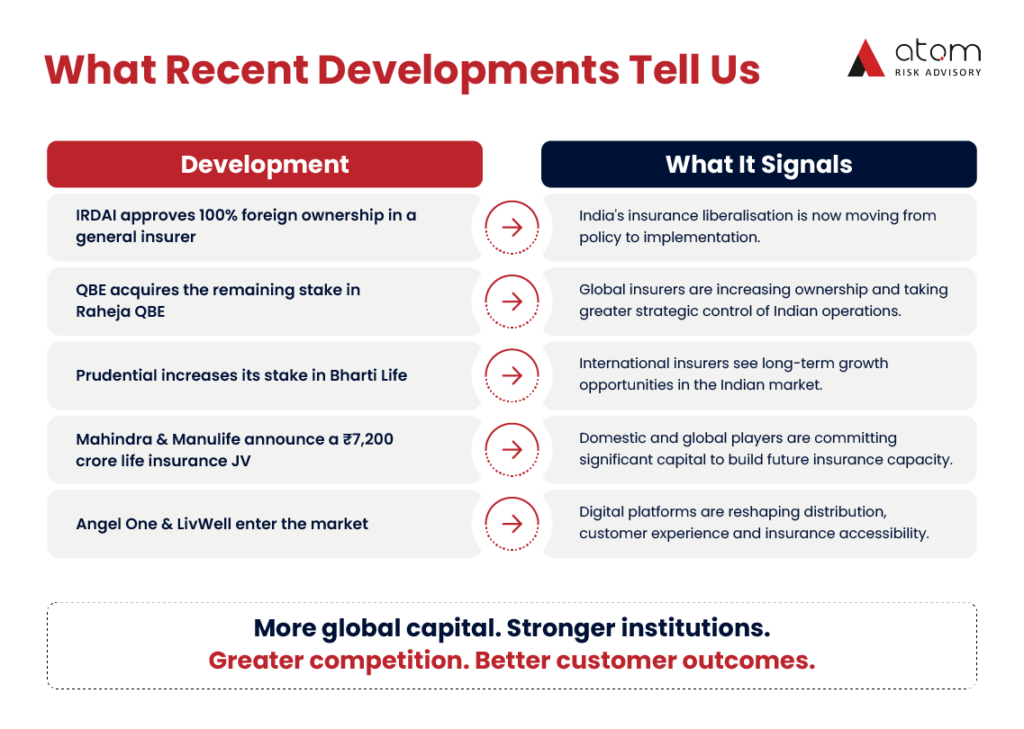
They indicate that India’s insurance market is entering a new phase – one characterised by stronger institutions, deeper capital pools, increased competition and evolving customer expectations.
The Real Story Isn’t More Capital. It’s What Capital Changes.
Foreign investment does far more than strengthen an insurer’s balance sheet.
It influences governance standards, underwriting discipline, technology investments, claims management, product development and long-term strategic priorities.
Global insurers entering India bring decades of experience across mature markets together with sophisticated risk modelling, stronger capital backing and established governance frameworks. These capabilities have the potential to strengthen the overall market while raising expectations around underwriting quality, solvency, customer conduct and operational resilience.
For policyholders, these developments are overwhelmingly positive.
Greater competition generally leads to better products, stronger service standards, improved innovation and wider insurance access.
However, they also change the way businesses should think about insurance relationships.
Increasingly, it is not only the policy that matters. It is the institution standing behind the policy.
Your Insurance Partner May Look Very Different Tomorrow
Insurance relationships are often built over many years. Ownership structures, however, can change much faster.
As acquisitions, joint ventures and strategic investments continue, organisations may find themselves renewing policies with insurers whose shareholders, leadership priorities and underwriting philosophy have evolved considerably since the relationship first began.
That does not necessarily represent a risk.
In many cases, new ownership brings stronger financial backing, improved governance and enhanced capabilities.
Nevertheless, businesses should recognise that the institution standing behind their policy may change over time.
Insurance buying should therefore move beyond an annual procurement exercise and become part of a broader assessment of long-term counterparty relationships.
Three Second-Order Effects Every Business Should Watch
Beyond the headlines, three structural shifts deserve particular attention.
First, counterparty risk is becoming increasingly important.
Insurance has traditionally been evaluated on coverage, pricing and service.
Going forward, businesses should also consider ownership structures, financial strength, governance standards and long-term strategic commitment.
Second, global standards are raising expectations.
International insurers are likely to introduce stronger underwriting discipline, enhanced solvency management, more rigorous governance and increasingly sophisticated risk analytics.
Businesses should expect underwriting to become more data-driven and risk assessments more comprehensive.
Finally, digital innovation is changing the nature of risk itself.
Technology-led distribution, embedded insurance, AI-enabled underwriting and digital claims management are transforming customer experience.
At the same time, they introduce new cyber, operational and third-party technology risks that organisations should evaluate with equal diligence.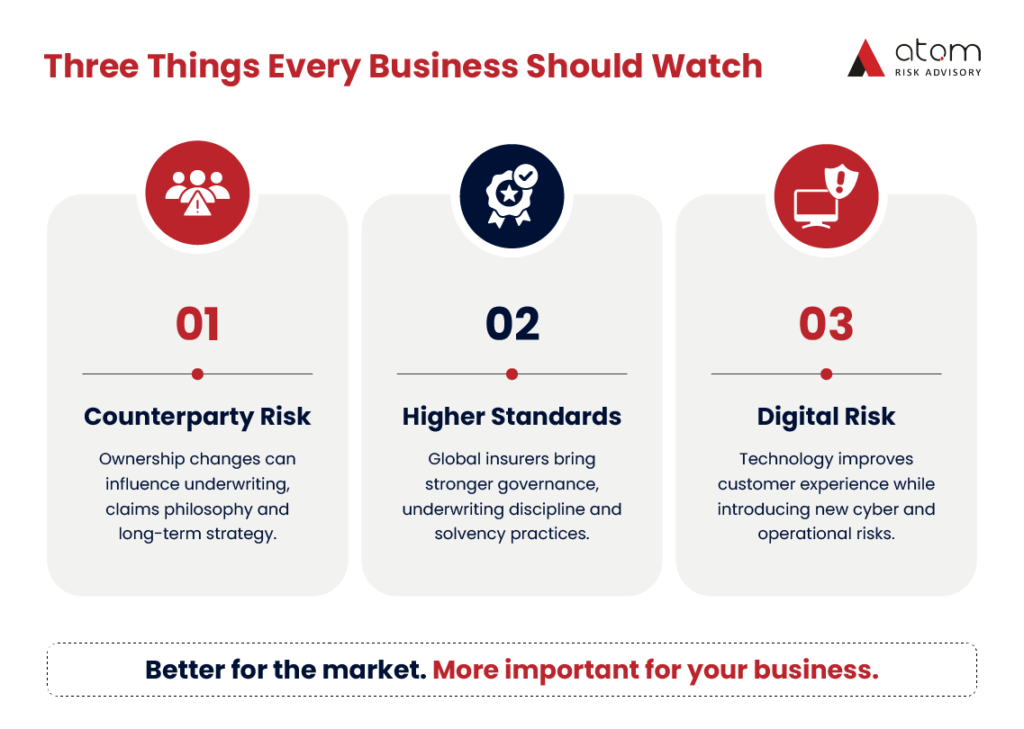
India Is Part of a Larger Global Trend
India’s insurance liberalisation is not occurring in isolation.
Markets including China, Indonesia and Vietnam have progressively opened their insurance sectors to greater foreign participation over the past two decades. Mature insurance markets across North America, Europe and parts of Asia demonstrate how stronger capital, disciplined underwriting and robust governance contribute to long-term industry resilience.
The pattern across these markets has been remarkably consistent.
Capital enters quickly. Institutional change takes longer.
The greatest long-term benefits emerge not simply from increased investment, but through stronger governance, improved claims practices, better customer outcomes and sustained competition.
India now has an opportunity to accelerate along a similar path.
What Should Corporate Buyers and Boards Be Doing?
Against this backdrop, selecting an insurer requires broader evaluation than ever before.
Alongside coverage, pricing and policy terms, organisations should consider:
- Financial strength and long-term capital backing.
- Ownership structure and strategic direction.
- Claims philosophy and settlement track record.
- Governance and solvency standards.
- Technology resilience and cyber maturity.
- Industry expertise and risk engineering capabilities.
- Commitment to supporting clients over the long term.
- Ability to support increasingly global business operations.
The same rigour businesses apply to selecting lenders, banking partners and strategic suppliers should increasingly be applied to selecting insurers.
Insurance is no longer simply a transfer of risk. It is the selection of a long-term financial partner.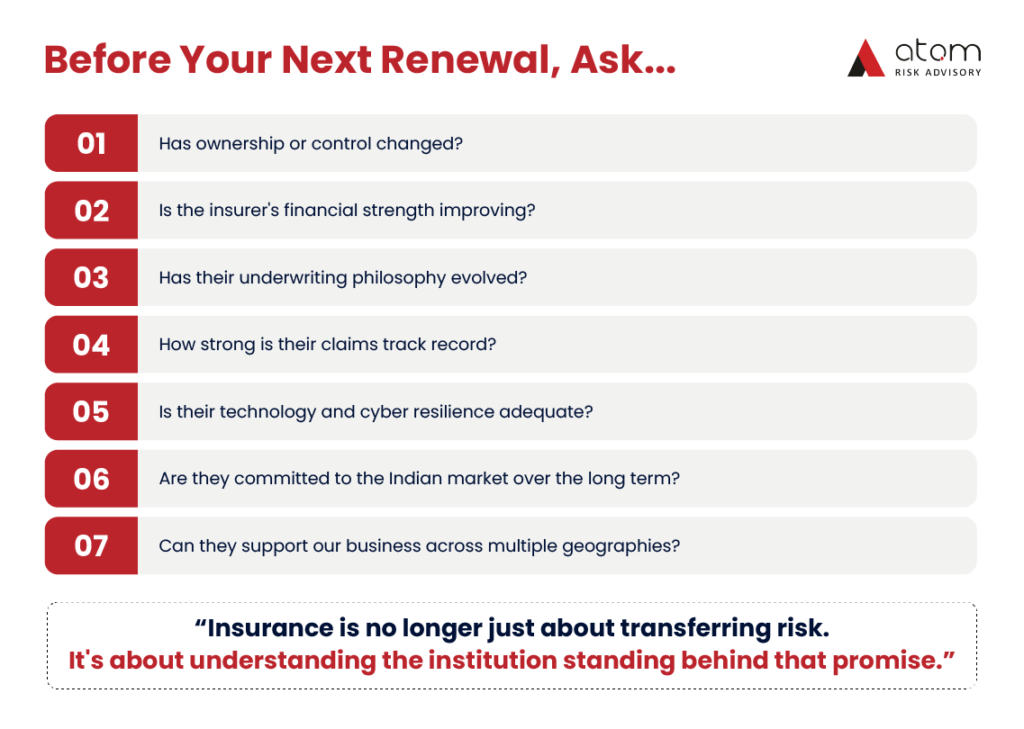
Looking Beyond the Policy
The next chapter of India’s insurance industry will not simply be defined by higher foreign investment.
It will be defined by stronger institutions, deeper competition, better governance and higher expectations from both insurers and policyholders.
For business leaders, this presents an opportunity, not merely to renew insurance programmes, but to reassess whether their insurance partners remain aligned with the organisation’s evolving risks, growth ambitions and long-term objectives.
The organisations that benefit most will not necessarily be those paying the lowest premiums.
They will be those that periodically re-evaluate their insurance relationships with the same discipline they apply to their lenders, strategic partners and capital providers.
Because in a rapidly changing insurance market, understanding your insurer has become just as important as understanding your insurance.
For boards, businesses, CFOs and corporate leaders, now may be the right time to ask not just whether your insurance programme is adequate, but whether the institution standing behind it continues to be the right long-term partner.
At Atom Risk Advisory, we believe this is an opportune time for organisations to review their insurance strategy – not just through the lens of coverage and cost, but through long-term resilience, counterparty strength and business continuity.
As India’s insurance landscape continues to evolve, organisations that periodically reassess their insurance strategy will be better positioned to navigate change with confidence.
If your organisation is reviewing its insurance programme or broader risk strategy, Atom Risk Advisory would be pleased to support that conversation.